Primary Navigation

ViewSpace ViewSpace Homepage
  • Home
    • Image Tours Library
    • Image Sliders Library
    • About the Interactives
    • Video Library
    • Video Collections
    • About the Videos
    • Museum Resources
    • Exhibit Labels
    • Setup Guide
    • Contact Us
  • Venue Login

Video Library

Newest
Oldest
Shortest
Longest
A - Z
Z - A

Filter Settings

Items Per Page:

Total (483)

Applied Filters:

Search Results

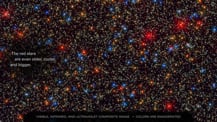
  • Above and Beyond: Star Cluster Omega Centauri

    Image of Star Cluster Omega Centauri. Text at left reads "The red stars are even older, cooler, and bigger."
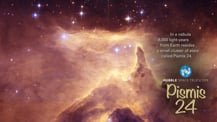
  • Above and Beyond: Star Cluster Pismis 24

    Image of Star Cluster Pismis 24. Text toward the top right reads "In a nebula 8,000 light-years from Earth resides a small cluster of stars called Pismis 24." Below is a small blue and white graphic of Hubble and text that reads "Hubble Space Telescope." In the bottom right corner is light brown text that reads "Pismis 24."
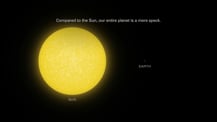
  • Insight Into: Sizes of Stars

    Artist's concepts of the Sun and Earth. Text appears at top.
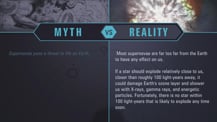
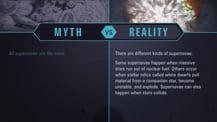
  • Myth vs Reality: Star Life Cycle

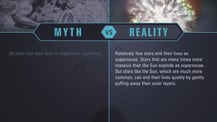
    A simple chart with two columns, each with a header image: a mythical drawing on the left and an image of stars, gas, and dust on the right. The "Myth vs. Reality" logo appears toward the chart's top, with "Myth" positioned at the top of the left column, and "Reality" positioned at the top of the right column. Both columns have text.
  • At a Glance: Types of Nebulae

    Collage of three different nebula types. Each image has a label toward its bottom, from left to right: "planetary nebulae," "supernova remnants," and "star-forming nebulae." Text toward the top reads "at-a-Glance, Different Kinds of Cosmic Clouds." Text near the bottom of the star-forming nebulae image reads "Instead of stellar graveyards, some nebulae are stellar nurseries."
  • Celestial Tour: Birthplace of Destruction—The Orion Trapezium Cluster

    Image of a section of the Orion Nebula. Text toward the left reads "Giving birth to stars is a thankless job."
  • Above and Beyond: Star Cluster NGC 602

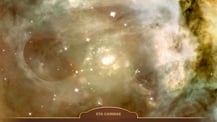
    Image of Star Cluster NGC 602. Text toward the top right reads "Potent winds and high-energy radiation let loose by the young stars are eating away at the inner edge of the nebula."
  • Above and Beyond: The Tarantula Nebula

    Image of the Tarantula Nebula. Text at right reads "Their cosmic résumé includes a variety of ridges, pillars, and valleys carved out of the nebula's gas and dust."
  • Above and Beyond: Star Formation in the Whirlpool Galaxy

    Image of the Whirlpool Galaxy. Text in the top right corner reads "As stars form within these nebulae, their strong stellar winds and searing ultraviolet radiation blow away their veils of gas."
  • Above and Beyond: Thackeray’s Globules

    Image of Thackeray's Globules. Text toward the center left reads "These clouds, however, show signs of disruption and breakup — likely side effects of residing near hot, massive stars that have already burst to life."
  • Insight Into: Star Formation

    Artist's concept of a dying star at left and a cloud of dust and gas at right. Text appears toward the lower right.
  • Above and Beyond: Planetary Nebula NGC 2440

    Image of Planetary Nebula NGC 2440. A yellow circle in the top right corner has red text that reads "Planetary Nebula NGC 2440." Text toward the bottom left reads "The nebula's bow-tie shape suggests the star might have released its gas in multiple bursts and in different directions."
  • Myth vs Reality: Shapes of Planetary Nebulae

    A simple chart with two columns, each with a header image: a mythical drawing on the left and an image of a planetary nebula on the right. The "Myth vs. Reality" logo appears toward the chart's top, with "Myth" positioned at the top of the left column, and "Reality" positioned at the top of the right column. Both columns have text.
  • Myth vs Reality: What Is a Planetary Nebula?

    A simple chart with two columns, each with a header image: a mythical drawing on the left and an image of a planetary nebula on the right. The "Myth vs. Reality" logo appears toward the chart's top, with "Myth" positioned at the top of the left column, and "Reality" positioned at the top of the right column. Both columns have text.
  • At a Glance: Shapes of Planetary Nebulae

    In the top left corner is text that reads "at-a-Glance." A yellow circle to the left has text that reads "Shapes of Planetary Nebulae." A list of four tabs, each listing a different shape of planetary nebulae, appear further below. Toward the right is an artist's concept of a bipolar planetary nebula. Text appears above the artist's concept.
  • Celestial Tour: Planetary Nebulae—Sculptures in the Sky

    Image of gas and dust forming a bubble-like structure as it is blown into space. Text at top reads "The "face" of the clown looks like a ball of twine, but is really a bubble of gas and dust being blown into space by a strong "wind" from the star."
  • Above and Beyond: Cat’s Eye Nebula

    Image of Cat's Eye Nebula. A yellow circle in the top right corner has text that reads "Cat's Eye Nebula." Text at left reads "A pair of wobbling jets might have pushed away some of the gas into two swirling tendrils on either end."
  • Above and Beyond: Planetary Nebula NGC 6302

    Image of Planetary Nebula NGC 6302. A yellow circle in the top right corner has red text that reads "Planetary Nebula NGC 6302." Text toward the bottom left reads "The gas in the wings is expanding through space at more than 600,000 miles an hour — fast enough to travel from Earth to the Moon in 24 minutes."
  • Insight Into: The Fate of the Sun

    Artist's concept of a planet with the Sun in the background.
  • Myth vs Reality: Galaxy Differences

    A simple chart with two columns, each with a header image: a mythical drawing on the left and an image of a galaxy on the right. The "Myth vs. Reality" logo appears toward the chart's top, with "Myth" positioned at the top of the left column, and "Reality" positioned at the top of the right column. Both columns have text.

  • « First
  • ‹ Prev
  • …
  • 20
  • 21
  • 22
  • 23
  • 24
  • …
  • Next ›
  • Last »
  • « First
  • ‹ Prev
  • …
  • 21
  • 22
  • 23
  • …
  • Next ›
  • Last »

Footer

Secondary Navigation

  • Contact Us
  • Terms & Conditions
  • Accessibility Statement
  • Site Map

Disclaimer

ViewSpace video content contains copyrighted material and should not be downloaded or used outside of this website.

This product is based upon work supported by NASA under award numbers NNX16AC65A and NNX15AB26G and contracts NAS5-26555 and NAS5-03127. Any opinions, findings, and conclusions or recommendations expressed in this material are those of the author(s) and do not necessarily reflect the views of the National Aeronautics and Space Administration.