Primary Navigation

ViewSpace ViewSpace Homepage
  • Home
    • Image Tours Library
    • Image Sliders Library
    • About the Interactives
    • Video Library
    • Video Collections
    • About the Videos
    • Museum Resources
    • Exhibit Labels
    • Setup Guide
    • Contact Us
  • Venue Login

Video Library

Newest
Oldest
Shortest
Longest
A - Z
Z - A

Filter Settings

Items Per Page:

Total (493)

Applied Filters:

Search Results

  • Celestial Tour: A Celestial Light Echo

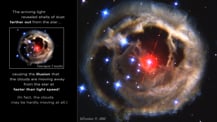
    Image of V838 Monocerotis at right. On the left is a panel that shows a smaller image of V838 Monocerotis. Text above and below the image reads "The arriving light revealed shells of dust farther out from the star...causing the illusion that the clouds are moving away from the star at faster than light speed! (In fact, the clouds may be hardly moving at all.)"
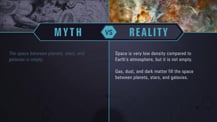
  • Myth vs Reality: Empty Space

    A simple chart with two columns, each with a header image: a mythical drawing on the left and an image of the Carina Nebula on the right. The "Myth vs. Reality" logo appears toward the chart's top, with "Myth" positioned at the top of the left column, and "Reality" positioned at the top of the right column. Both columns have text.
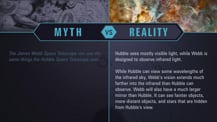
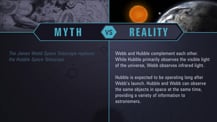
  • Myth vs Reality: Seeing with Webb vs Seeing with Hubble

    Screen grab from video. A simple chart with two columns, each with a header image: a mythical drawing on the left and an image of the Carina Nebula on the right. The "Myth vs. Reality" logo appears toward the chart's top, with "Myth" positioned at the top of the left column, and "Reality" positioned at the top of the right column. Under Myth, text reads, The James Webb Space Telescope is an improved version of the Hubble Space Telescope.
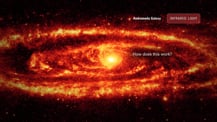
  • At a Glance: Seeing the Invisible—Using Infrared to See Dust

    Image of the Andromeda Galaxy. Text in the top right corner reads "Andromeda Galaxy." A red box to the right has text that reads "Infrared Light." Text toward the center right reads "How does this work?"
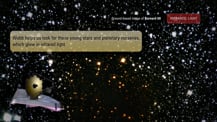
  • Celestial Tour: Star Birth and Planet Formation

    Artist's concept of the James Webb Space Telescope in the lower left corner against a field of fuzzy points of light. Text in the top right corner reads "Ground-based image of Barnard 69." A red box to the right has text that reads "Infrared Light." A yellow box toward the top left has text that reads "Webb helps us look for these young stars and planetary nurseries, which glow in infrared light."
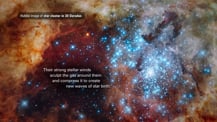
  • Above and Beyond: 30 Doradus

    Image of 30 Doradus. Text in the top left corner reads "Hubble image of star cluster in 30 Doradus." Text toward the bottom left reads "Their strong stellar winds sculpt the gas around them and compress it to create new waves of star birth."
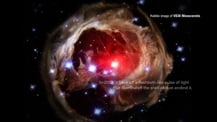
  • Above and Beyond: V838 Monocerotis

    Image of V838 Monocerotis. Text toward the top right corner reads "Hubble image of V838 Monocerotis." Text toward the bottom right reads "In 2002, it gave off a flashbulb-like pulse of light that illuminated the shell of dust around it."
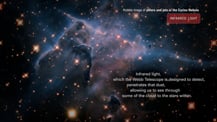
  • Above and Beyond: Mystic Mountain—Pillars and Jets in the Carina Nebula

    Telescope image of the Carina Nebula. Text toward the top right corner reads "Hubble image of pillars and jets in the Carina Nebula." A red box just below has text that reads "Infrared Light." Text near the bottom right corner reads "Infrared light, which the Webb Telescope is designed to detect, penetrates that dust, allowing us to see through some of the cloud to the stars within."
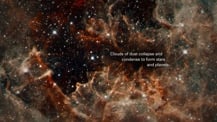
  • Insight Into: Cosmic Dust

    Image of brown and red clouds of dust against a star-filled background. Text appears toward the lower right.
  • Myth vs Reality: The Webb and Hubble Space Telescopes

    Screen grab from video. A simple chart with two columns, each with a header image: a mythical drawing on the left and an artist's concept of the Sun and Earth on the right. The "Myth vs. Reality" logo appears toward the chart's top, with "Myth" positioned at the top of the left column, and "Reality" positioned at the top of the right column. Under myth is text that reads The James Webb Space Telescope replaces the Hubble Space Telescope.
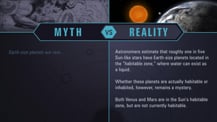
  • Myth vs Reality: Abundance of Earth-sized Planets

    A simple chart with two columns, each with a header image: a mythical drawing on the left and an artist's concept of the Sun and Earth on the right. The "Myth vs. Reality" logo appears toward the chart's top, with "Myth" positioned at the top of the left column, and "Reality" positioned at the top of the right column. Both columns have text.
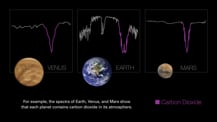
  • At a Glance: Exploring Alien Atmospheres

    Toward the top are three spectral graphs of Venus, Earth, and Mars. Artist's concepts of the planets appear toward the bottom. Text appears toward the bottom left.
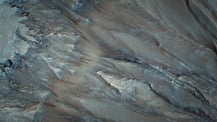
  • Above and Beyond: Water on Mars

    Satellite image of Mars' surface.
  • Above and Beyond: Icy Europa

    Image of Europa. Text in the top right corner reads "Jupiter's moon Europa." Text toward the top left reads "We have seen signs of liquid water on other  bodies in our own solar system."
  • Insight Into: Water and Life

    Image of a steaming hot spring. Text appears toward the left.
  • Myth vs Reality: Understanding How Galaxies Change

    Screen grab from video. A simple chart with two columns, each with a header image: a mythical drawing on the left and an image of a field of stars and galaxies on the right. The "Myth vs. Reality" logo appears toward the chart's top, with "Myth" positioned at the top of the left column, and "Reality" positioned at the top of the right column. Under Myth, text reads, We can't watch galaxies change, so we can't understand how they evolve over time.
  • Myth vs Reality: Stars, Light, and Time

    A simple chart with two columns, each with a header image: a mythical drawing on the left and an image of a field of stars and galaxies on the right. The "Myth vs. Reality" logo appears toward the chart's top, with "Myth" positioned at the top of the left column, and "Reality" positioned at the top of the right column. Both columns have text.
  • At a Glance: The First Galaxies—Observing with the Webb Space Telescope

    A grid-like collage of early galaxies. Text toward the bottom reads "And extremely early galaxies often appear as smallish blobs of stars."
  • Celestial Tour: The Journey of Light

    Artist's concept of the James Webb Space Telescope against a field of galaxies.
  • Above and Beyond: Observing Infrared from Early Galaxies

    Infrared image of the Hubble Ultra Deep Field. Text in the top right corner reads "Hubble Ultra Deep Field in Infrared." Text in the center reads "The James Webb Space Telescope can see even younger galaxies, in more detail, deeper in the cosmos."

  • « First
  • ‹ Prev
  • …
  • 18
  • 19
  • 20
  • 21
  • 22
  • …
  • Next ›
  • Last »
  • « First
  • ‹ Prev
  • …
  • 19
  • 20
  • 21
  • …
  • Next ›
  • Last »

Footer

Secondary Navigation

  • Contact Us
  • Terms & Conditions
  • Accessibility Statement
  • Site Map

Disclaimer

ViewSpace video content contains copyrighted material and should not be downloaded or used outside of this website.

This product is based upon work supported by NASA under award numbers NNX16AC65A and NNX15AB26G and contracts NAS5-26555 and NAS5-03127. Any opinions, findings, and conclusions or recommendations expressed in this material are those of the author(s) and do not necessarily reflect the views of the National Aeronautics and Space Administration.