Primary Navigation

ViewSpace ViewSpace Homepage
  • Home
    • Image Tours Library
    • Image Sliders Library
    • About the Interactives
    • Video Library
    • Video Collections
    • About the Videos
    • Museum Resources
    • Exhibit Labels
    • Setup Guide
    • Contact Us
  • Venue Login

Video Library

Newest
Oldest
Shortest
Longest
A - Z
Z - A

Filter Settings

Items Per Page:

Total (24)

Applied Filters:

Search Results

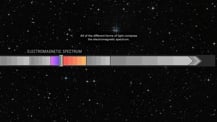
  • Insight Into: The Electromagnetic Spectrum

    The electromagnetic spectrum is depicted as a mostly grayscale bar that runs horizontally across a starry, black background. Text at left, just above the bar, reads "Electromagnetic Spectrum." Toward the bar's center left is a colorful section that starts as purple at left before moving to a narrow rainbow-colored section. It then becomes red before ending as a light orange at the right end. Text at center, above the bar, reads "All of the different forms of light compose the electromagnetic spectrum."
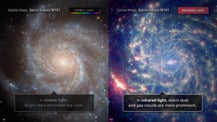
  • At a Glance: Galaxy M101 in Infrared Light

    Two side-by-side images of spiral galaxy M101 as seen in visible light by the Hubble Space Telescope and infrared light as imaged by the Spitzer Space Telescope. A gray box toward the bottom left reads "In visible light, bright stars dominate the view." A gray box toward the bottom right reads "In infrared light, warm dust and gas clouds are more prominent."
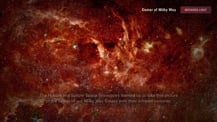
  • Above and Beyond: The Milky Way Center in Infrared Light

    Infrared image of the Milky Way center. Text toward the top right corner reads "Center of Milky Way." A red box on the right has text that reads "Infrared Light." Text at bottom reads "The Hubble and Spitzer Space Telescopes teamed up to take this picture of the center of our Milky Way Galaxy with their infrared cameras."
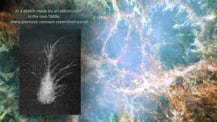
  • Celestial Tour: A Star's Demise—Origin of the Crab Nebula

    A close-up of the Crab Nebula overlaid with a black-and-white sketch of the object on the left. Text in the top left corner reads "In a sketch made by an astronomer in the mid-1800s, the supernova remnant resembled a crab."

  • « First
  • ‹ Prev
  • 1
  • 2
  • Next ›
  • Last »
  • « First
  • ‹ Prev
  • 1
  • 2
  • Next ›
  • Last »

Footer

Secondary Navigation

  • Contact Us
  • Terms & Conditions
  • Accessibility Statement
  • Site Map

Disclaimer

ViewSpace video content contains copyrighted material and should not be downloaded or used outside of this website.

This product is based upon work supported by NASA under award numbers NNX16AC65A and NNX15AB26G and contracts NAS5-26555 and NAS5-03127. Any opinions, findings, and conclusions or recommendations expressed in this material are those of the author(s) and do not necessarily reflect the views of the National Aeronautics and Space Administration.